Host:
Dr. Erica Warren, Darius Namdaran

Cart
Your cart is empty
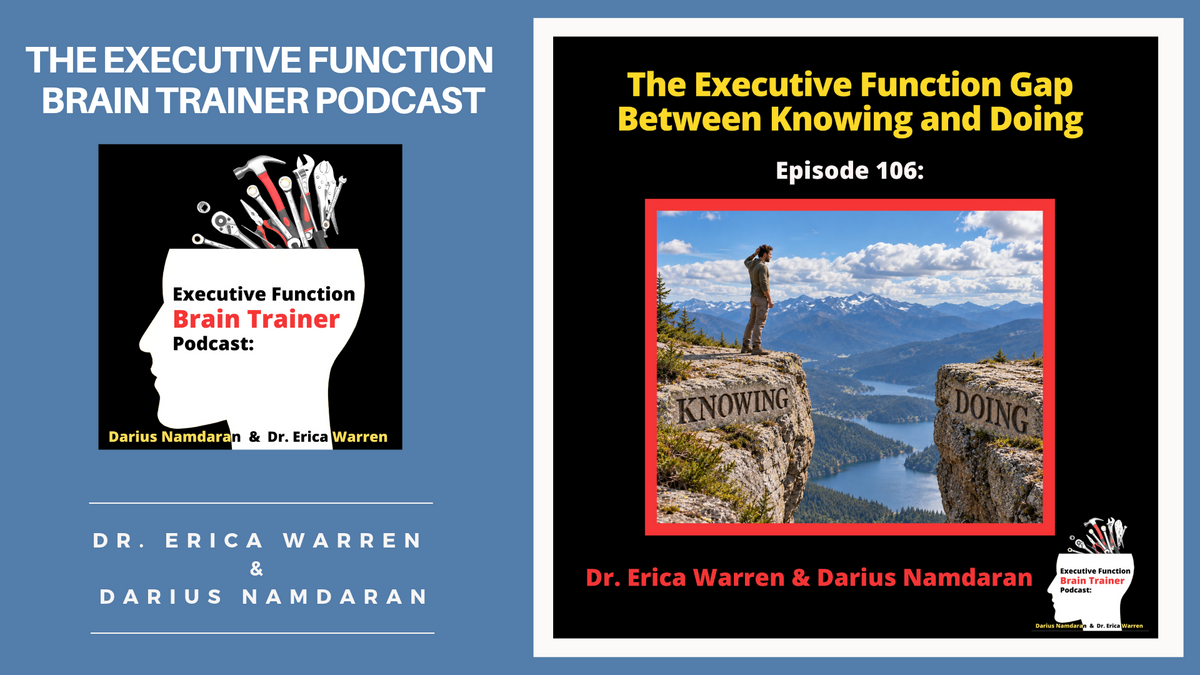
#106 The Executive Functioning Gap between Knowing and Doing
Host:
Dr. Erica Warren, Darius Namdaran
Ideal Audience:
Parents, Educators, Students, Adults, Practitioners
Episode Summary
In this episode of the Executive Function Braintrainer Podcast, hosts Darius Namdaran and Dr. Erica Warren explore the gap between knowing what needs to be done and actually doing it. They explain how task initiation can be blocked by hidden barriers such as unclear instructions, working memory challenges, time blindness, perfectionism, anxiety, low energy, and tasks that feel too large or difficult to begin. The hosts share practical ways to bridge this gap, including making the next step extremely easy, breaking projects into manageable chunks, externalizing information, creating starting rituals, using body doubling, and defining what is good enough. Darius introduces the Three Ts: technique, tool, or team, as a simple framework for making difficult tasks more approachable. They also discuss the value of curiosity over self-blame and explain how understanding personal learning patterns can help people find strategies that genuinely work for them. Ultimately, the episode shows that difficulty taking action is not simply a lack of motivation, but often an executive functioning challenge that can be understood and supported.
Listen
Watch
resources mentioned
brought to you by
Erica: Welcome to the Executive Function Brain trainer podcast. I'm Dr. Erica Warren.
Darius: And I'm Darius Namdaran and we're your hosts.
Erica: Hey Darius, great to see you today.
Darius: Hey Erica, nice to be here. What's our topic today?
Erica: We're going to be talking about the executive functioning gap between knowing and doing all those little things that we're like, I know I need to get this done, I know I need to get this done. And we can have our little list. And sometimes they're those key things that are actually quite urgent to be done. But we're doing all the other things that aren't as urgent first because for some reason there's this little tripping point, this little gap that's getting in our way. And I thought that would be a really, really interesting thing for us to mull over today.
Darius: Yes, that's a biggie. We know what we should do, but we don't do it. Why? And how do we get to the point where we do what we know we should do or even know what we want to do? But there's a difference between what you should do and what we want to do.
Erica: That's right. That's right. Well, and why is it easy to do some things and hard to do others? And you know, and really, we need to understand what the difference is between knowing and doing.
Darius: Yeah.
Erica: So knowing is a, ah, cognitive understanding where doing requires a whole set of skills, whole set of executive functioning skills. Ding, ding, ding, ding.
Darius: Absolutely.
Erica: Initiating, prioritizing, holding steps in your mind. Right. Regulating emotion, estimating time, shifting attention, sustaining effort. That's a good one. So let's talk a little bit about why we get stuck.
Darius: Yeah, I think there's a lot in there. And this is a lot to do with initiation, knowing what you should do and then doing it. There's a lot to do with initiation. And when I was an executive function coach, in my day-to-day life as part of this business, which I don't do now because, I spend most of my time running the business itself, I realize that there are some hidden trip wires that stop you doing what you want to do. Now there's a, I think there's a big difference between what you should do and what you want to do. Okay. So we all know that there's lots of internal resistance towards what we should do, but it's not really what we want to do. It's just like a, to do that we have to do. And that's hard to, to initiate. We could talk about that. But actually I think what's more interesting is to look at what would seem very obvious and easy, which is I know what I want to do, but then I don't do it. And you would think logically, maybe you really want to go out and meet someone at the weekend, but you don't reply Back to the WhatsApp and make the time. It's something that you, you want, but you don't do it. And I think that's probably the really fascinating element of this because once you realize what's getting in the way of what you actually want to do, and it's not just a question of motivation, you start to realize what the gap actually is. And that the gap isn't always just motivation because it normally just gets. Gets blamed on motivation. Just get more motivated. And that's not always the answer.
Erica: There's always something behind the motivation anyway. Motivation is just this, this thing we throw out there as kind of like a blanket. Like, oh, I'm not motivated, but there's something behind it. There could be fear, it could be, you know, trepidation. Motivation never really gets to the core of what the issue is.
Darius: Agreed. And I think that's why it's good to just put it to the side. And let's say, let's not get distracted by how to solve this gap by focusing in on motivation first. There are other things that are much lower hanging fruit that actually help bridge this gap.
Erica: That's right. And I think, and this is where we're, let's try to figure out what that the low hanging fruit is and what are those hidden barriers or what, what are those tripping points. And I think, you know, I can get us started. I mean, you've kind of mentioned a couple already.
Darius: Go for it. Give us a list.
Erica: Maybe a task is too vague. So we don't really, we don't have a sense of what the. A clarity on the first step, which has to do a little bit with the initiation like you were talking about. You know, I don't know how to get started. Right. Too many open loops, you know, which can
00:05:00
Erica: overwhelm working memory at, the task is too big. Right. It's just overwhelming. I don't know where to get started. So it's not an issue of getting, you know, getting started, it's where... Well, interesting. It makes me almost think of the five W's. Where, what, who, when, why? And that's interesting. It would be interesting to explore whether answering the five W's would help you to get started because, you know, how can you be on a path if you can't see it? And every task is a path.
Darius: So, like, I thought about this really deeply a couple of years ago and created a little framework for how to do this. And, the framework was, you know, the framework, important and urgent that. That grid, what's it called?
Erica: Yeah, there have been a few people that have offered grids about that, about that. Stephen Covey was one.
Darius: Yeah, important and urgent. Important, not urgent. And then there's other things that are unimportant and urgent and unimportant and not urgent. And you've got these four boxes. You can put things. However, I often didn't live in any of those boxes because there's a step before that. There are certain things that are important and urgent and important and not urgent, but you don't do them. And that's what we're talking about, things that are important that you want to get done. And there's this scale of easy to hard. And it's as simple as that. Is the task you're going to do. Easy to do. Hard to do. And my definition of easy to do is can you do it with less than 60 seconds of preparation? Then it's easy to do if you can do it immediately. So if you've got a task that you really want to do, and I've got to reply to my friend to book Saturday, we want to go play golf, but I've got to go and speak to my wife. My wife's not here. I don't know what I'm doing on Saturday. That's not. I can do it in less than 60 seconds. But if you can look at your calendar on the Saturday morning and you can say, yeah, we're going for a walk in the afternoon, we're going to go do this in the evening, I've got the morning. Yes. Text them back, what's a, 8:30 teatime like for you on Saturday? He texts back saying, yes, right, see you then. That's the difference between easy to do and hard to do. And I find that, and the depth of that is quite broad because if you've got dyslexia or adhd, that can actually make certain things that might be easy to do for someone else. On the face of it, actually still pretty hard to do. And that initiation test, can you initiate it with less than 60 seconds of work? I mean, yeah, there might be, you know, and that basically means, can you get started?
Erica: Shortcuts. Is there a shortcut?
Darius: Yes and no. It's kind of.
Erica: Well, that was what your description was. Your description was shortcuts. But I've heard you talk about this before, and I have to say that I've integrated it into my practice.
Darius: Really?
Erica: Because when I have a student that's kind of frozen, and I say, you know what? This task is really hard, isn't it? And they're like, yes. So I build some compassion. Well, what if we could make it easy? It creates, like, an opening. It cracks a crevice where the light comes through. And they're like, oh, wow, really? What does that mean? How can we do that? And then you explore with them. okay. What would be another, easier way to do this, which is really about cognitive flexibility? Because when we're stuck and looking at that gap, we're not being cognitively flexible. We think that there's only one path, and we just don't know how to navigate it because there's a bear in the way, there's a boulder in the way, and there's no way to get through. And we're stuck because we're like, but I have to get through. This is where I have to go. And in fact, there might be a path to the left, and in fact, it might even be a shorter path to the destination.
Darius: I've got a mental checklist that I go through, which I call the three T's. Is there a technique I can use to make this easier to get done? Less than one minute to initiate it. Is there a tool I can use, or is there a team? And so what tends to happen is often techniques are really useful for bridging this gap, to shift a task from hard to easy. And I don't mean hard to do. I mean
00:10:00
Darius: hard to initiate it. Okay. And there's a big difference. A lot of people are motivated. They don't mind hard work. But it's really annoying when it's kind of impossible work. It's kind of like, I can't reply to my friend. So impossible. I don't, have my wife with me. I don't know what's happening on Saturday. There's an impossibility. There's this wall, but is there some way to move it from hard to start to easy to start? And that normally means a technique. And if a technique doesn't do it, I upscale to a tool because a tool often has a procedure in it that solves a procedure, and I don't need to think about the process. And then if the tool doesn't do it like a calendar or Whatever. I might need a team. I might need a person to do it with me, you know? And so often those three things really help me.
Erica: Yeah. Yeah, I think you're right. I think self-initiation is often one of the biggest barriers, but there are other ones, because there could be personality characteristics too, like perfectionism or fear of the wrong choice, and that can create emotional friction. Right.
Darius: Yeah.
Erica: Which is different. That's a different gap.
Darius: And that's a barrier, isn't it? It's this. A barrier towards initiation, that fear, that anxiety, you know, and someone might look at it, and you might even look at it. I talk about this, like, big me and little me. Big Darius goes. Adult Darius goes, oh, what's so hard? You just do this. And little Darius is going, yeah, yeah. But the last time I did that, they laughed at me or I felt embarrassed or, you know. And big you goes, oh, come on. Don't be so silly. But then you still don't do it because you're not fully in accord, you know?
Erica: Yep. Yep. Absolutely. I love that. I love it when you talk about big Darius and little Darius. Yeah. Because I think we all have those parts. And sometimes it might not be. For me, it may not be a big Erica and a little Erica. It might be a different part. It might be a fearful part, or it might be an angry part. Right. And we all have those parts. And perhaps that's another thing to consider as a hidden barrier that we may be stuck in a part that's not being helpful.
Darius: That's the key thing. There is hidden barriers here. You know, it could be learning disabilities or learning differences, depending on how you view them. Like dyslexia, the process of getting to something because it's a procedural difference. Processing difficulty, process of reading it, the process of writing it, the process of just going through them. The task itself is overwhelming. And so it might seem easy, but there's an invisible barrier. Adhd, et cetera.
Erica: Even with the learning disabilities or adhd, it may not be your barrier. It might be the teacher's barrier. Because the teacher. Teacher is insisting that you follow a certain procedure that doesn't work for you.
Darius: Yes.
Erica: And you're like, oh, my God. I've tried that before. It doesn't work. There's another way that works better for me, but my teacher won't let me use it. And then the anxiety kicks in. And of course, anyone that have a learning. Has a learning disability when they. When they have the anxiety, then they're less capable. They kind of regress. They Lose their strategies, they lose their
Darius: tools, they lose their techniques, and they lose their confidence. And that often it can just be working memory. For example, a teacher said, just follow the normal process, the Peel process, for writing an essay or teal, wherever you are in the world. There's some variation of it. Point, evidence, explanation, link for a paragraph. And you do three of those in an essay. Make your point, give your explanation, give your evidence, give your explanation and link it to your next one. And then do the same again. Do the same again. Do three of them. Pop an introduction to the front, Pop a conclusion to the front, back that has those three points roughly in there. And Bob's your uncle; you've got a decent essay. Just follow Peel. And then someone goes, I can't remember what that process is because it's not in their working memory, you know, so it could be a working memory issue. And you'd be surprised how many problems of initiation are caused by working memory problems. Because someone says to you, for example, oh, gosh, yes, I wanted to do that sort of thing, oh, gosh, I can't remember exactly what I was meant to do there. And you're like, oh, I better come back to that once I do remember, or, once I find it, or whatever. And then you just say, I can't do that until I do that. And what should be the answer at that point? The answer is, is your task is not to do the job, but to find out the information to do the job. Can you find out the information? Can you find out that process
00:15:00
Darius: and you. Oh, well, yeah, I suppose I could. And the thing in my mind is, can you find out that information in less than 25 minutes?
Erica: Right.
Darius: Yes, I can.
Erica: I can't help but go back to your example of, you know, using an acronym like PEEL to help you to write something. And I, when you were talking about it, made me think of my little girl self. And when I was little, I probably would have reversed the whole thing and said, oh, it's leap. Yes, you know, and then. And then you're like, but wait, that doesn't make sense. Why is it all backwards? You know, like.
Darius: Right, that's right. Yeah. Yeah. Or it might have been even more subtle than that. Okay, you might have done Peel. Okay. Point, evidence, explanation, link. Okay, so. So you might then go actually, point, explanation, evidence, link. Okay. And you think, well, what's the big deal? It's all there. But to a reader, they're kind of like, oh, you've made a point. You know, the second World. The first World War was caused by a person called Franz Ferdinand. And then you explain it all and you didn't put your evidence in. So someone's like, you just give me this big explanation, but where's the evidence? Start with the evidence, start with the headline, start with the main thing and then explain it. And a lot of people with dyslexia, do that by nature. They'll explain the context. They'll explain in a story, oh, this happened over there and that happened over there. That happened. This happened. That happened. Well, what's the point of this story? Oh, oh yeah. Actually, it's all about this man trying to kill this dragon. Oh, well, thanks very much. Why didn't you tell me that at the beginning? You know, and they're telling you all the right things, but they're in the wrong order. And most people need the order for comprehension. We follow patterns to understand things.
Erica: But unfortunately, some people miss sequence. They do too. So, you know, it's a tough one, but I've got a new one. Time blindness. Yeah, that's a tough one. Those that have time blindness because it makes the tasks feel endless or it can make a task feel suddenly urgent, you know, But I am working with a student right now that has a lot of time blindness. And he's like, oh, yeah, yeah, yeah, I'll do this as soon as I get off. Yeah, no, no, no, no. I'll order those notebooks. It's interesting because I do have this student that, you know, school started beginning of September. And he's like, yeah, I need to get two more notebooks. I'm like, okay, so let's. Why don't we do that right now? No, no, no, no, no. I'll do it right after the session. Right after the session. I'm like, okay, well I'm also going to email your parents to her so that they can remind you. Okay, okay, okay. Next week comes and I'm like, all right. See? Did you get those two notebooks? No, no, no, But I think I have some up in the attic. I'll just, I'll get them out of the attic. And then four sessions later, I'm like, do you have the notebooks? He's like, no, no, I don't. I'm like, how are you taking notes?
Darius: So explain why you're tying that to time blindness for the listeners.
Erica: Because it has to do with time blindness. Has to do with time management. You know, and he thinks he's got all the time in the world. M and he thinks that he's got plenty of time tonight to do this. But it's interesting. The apple doesn't fall far from the tree. So both his parents also have a lot of these same issues. And between the three of them, it's just hard to get anything done. And there's so many hidden barriers. You know, there are barriers all around him. But yeah, I mean, the only. I realized that the only way to get it done is for us to do it together in the moment. We had to hop onto Amazon and order it right then and there. And interestingly enough, this became another hidden barrier to him getting his work done.
Darius: Yeah.
Erica: You know, so there were all, how can he take notes in class if he doesn't have a notebook? How can he get his homework done if he doesn't have his notes? So sometimes you're having to, like, backpedal to something that's surprisingly obvious and he doesn't admit it up front. If you don't ask the right question.
Darius: Well, we've talked about. What's the original question? Let's go back to the title, right?
Erica: The original title is the Executive Functioning Gap between Knowing and Doing. Yes, I know I need to get the notebooks but actually doing it.
Darius: And again, everything that we've been saying is still the gap between knowing and doing what will actually make you get doing it. And I think doing real life, practical, dynamic activities like sailing in nature or playing golf or kayaking or something, where you get immediate dynamic
00:20:00
Darius: feedback that is unrelenting. Like if you mess up in the sea and you, oh, I forgot to order that shackle and put it onto the back of my sail and then it breaks. When you're out at sea, you're over on your side in the boat, you're in the water and you're cold. Yes, you can get back in the boat, and you get back up and then you kick yourself and you, oh, I should have got that, you know, Or I can just do that really quickly. And then you can't. And you do it too slowly and something catastrophic happens. And what happens is you get this immediate feedback. There are a lot of people, including myself, with time blindness, adhd, dyslexia. I absolutely love being in real dynamic situations where I get real time feedback. Because often if he doesn't get the notebook, he doesn't experience the consequence until next week, which is forever away. But if the consequence is a minute or five minutes later or whatever, he can then adapt to that and learn from it and then learn again and learn again and learn it's that faster feedback loop that actually trains execution.
Erica: I think you're right. I think, you know, it's about finding something that you really want, you really love. Maybe you decide, I want to learn the guitar. Right. That's a great way to learn some of these skills.
Darius: Yes.
Erica: Or I really want to be a dancer. You can work through a lot of these barriers by finding something that you love to do. But I think that it's going to be unique for each individual. But I love that. I think that's.
Darius: And each one of those gives feedback, doesn't it? Your body gives you feedback. If you don't do something right, you fall over or it doesn't quite look right or whatever. If you're dancing, you know, you've got a certain move and a certain process that you go through. Oh, I can't get that sequence wrong, you know, on that procedure. Oh, right. I like. I find it really, really hard. If I go to a dance class, like, you know, these sort, of dance exercise classes, they do the same dance over and over again. And they just expect you, oh, I've just shown you the move 10 times. Well, I need to experience that move not 10 times. I need to experience it at least 70 times before I can start doing it without that. And I need to see it slow down step by step. Not once, but at least five to eight times before I then practice it, which is different than typical people. But I know that about myself.
Erica: So, yes, that's it.
Darius: If I know that about myself and I've experienced the pain of messing up so many times in my life, I don't go, gosh, there's so many barriers in my life. I can't do this. Life's not fair. Everyone should do this and that. And the dance teacher should be explaining it eight times instead of twice. No, I go, can I take a little video of you doing that? And I'll go home and I'll play it slowly over and over again and practice it myself so that I do those eight to 70 repetitions at home. So when I come, I can actually do it. And this is part of the key, is understanding what you're good at and what you're not so good at and what those domino problems are. And domino problems are things that compound. And once you know that you can start having a huge amount of independence to get what you've done, what you want done.
Erica: I think you're onto something. It's about knowing yourself, getting to know yourself, knowing yourself. And if you're not sure. Really analyzing something that you're good at and figuring out how you got there because that's those are going to be the tips and tricks that will help you to get anywhere, right?
Darius: Absolutely.
Erica: Sponsored by the Executive Functions Coaching and Study Strategies certification course. A comprehensive training for educators, coaches and parents
Darius: sponsored by ivvi. Imagine turning your meeting's audio into a live mind map instantly so you remember what matters. Well, try ivvi for free now at Ivy App. that's ivvi. App.
Erica: I think there's also a sense of moving from self-blame to curiosity. That's another huge key because if you can become curious, I mean I'm seeing that in a lot of my sessions. I see a lot of kids that are very filled with self-blame and if I can get them to be curious or even if I can be curious.
Darius: Right.
Erica: It seems to open up the aperture
00:25:00
Erica: to other avenues, you know, because the other thing is to want people to self-generate the path through because then they're more likely to follow it. If you say oh, it's just this way, they're going to be like no, you know. But if you, if you're curious and you say I'm curious. Do you think there's another way through this? What could that look like? Then we're getting, we're getting that self-generation. We're pulling them out of the self-blame and we're saying okay, I bet there's some wisdom in there. And you've actually said a few things. I just had a session yesterday that went brilliantly. You know, initially I was like, I think all the questions answer can be answered from within. And she was like, no, they can't. And then before long she was just spewing out all sorts of great ideas. Well, my friend does this. I was like wow, you just said something really brilliant. You said this. Oh, you know, but, but it's just amazing when people and if they can't come up with something, at the very least give them choices. So again there's some level of self-generation or choice, but I think curiosity. I really learned that when I went back and got certified as a life coach. And it's just brilliant because you know, I want to help people but if I'm always throwing at them ideas on what they can do, it just gets overwhelming. That self-generation of helping them to be more cognitive flexibility, you're really inviting them to be more cognitively flexible. And I have an activity that I do that I really love which is, well, let's look at it from different perspectives. What do you think your dog would say? What kind of advice would they have? What advice would a tree have? You know, what advice would your parents or a teacher or a mentor, what do you think their perspective might be? How do you think? I'm just curious what you think they would advise you. And it's fascinating what comes up. And then after you go through that activity, you can then say, is there anything else that this brings up? And then all of a sudden, they have choices. You know, it's really, it's a fun activity to do. Being cognitively flexible is such an incredible trait. And I think it really is a tool that can get you, you know, across that gap.
Darius: It's a huge advantage for people with dyslexia and adhd. Often, not always, but often they are more cognitively flexible. And maybe that's by default. But also circumstances, you know, they can't do it the standard way, so they've got to find an alternate way. And workarounds and things like that. Their work can't remember the process because of their working memory. They might have poor procedural habits. They can't just get into a rut and a habit. They're always improvising and always trying to refigure things out. One of the things that you mentioned, there was this self-blame. And I think the root of the self-blame sometimes is that the person thinks that they should be able to just do it. And there's this default, oh, I should just be able to do this. And you're like, no, no, no, no, no. And that's part of the curiosity where it's kind of like, you know, there's so much of life you learn and you do something, you reflect on it, you reflect on what worked and what didn't work and what your goal was. And then you change another action and you repeat, repeat that. You reflect on it and you learn and you go through lots of feedback loops. Like I was saying with, with real life. And we do that intuitively in real life. And no one would expect a person to just be able to do a dance, particular dance moves or whatever. No. You watch someone do it, you'd slow it down on TikTok or whatever, you'd practice out, you'd review it. And I think when people take away that pressure to be able to just be able to do it, that frees up a lot of this self-blame as well.
Erica: Yeah, And I also think it has a lot to do with coming up with really powerful questions like what Is making this hard? What is making it hard for you to start and really exploring that?
Darius: Yes.
Erica: Or what are some other questions? What is the smallest visible next step? Step. Sometimes that's enough to do it.
Darius: I have a little internal model, you know, that from easy to hard. Okay, that's right. Well, how would I define easy? Defining easy for me is, can I turn this into a task that I can complete in less than two minutes? And that would be easy. Easy.
00:30:00
Darius: You know, and then the maximum range of easy would be, can I do it in less than 25 minutes? Okay. And because some people might say, oh, that's quite easy, I can do that in two or three hours. And actually they've got a bit of time buying this and it's actually more like seven or eight or nine hours. And it'll take them two or three days to do that because they've got other responsibilities.
Erica: That's right.
Darius: And it actually takes three or four days and they, they stall in the middle of it. And it might take two or three weeks because they got stalled and, in the end, they think they're low motivated and they're procrastinating. No, they've just not made the task doable.
Erica: Right.
Darius: And my definition of doable is, can I get it down? You asked about questions. Can you do this? Is there a way where we could do this task in less than two minutes? And it's a very interesting question, so I'll give you an example.
Erica: It's a very motivating question too.
Darius: Yeah. Someone says, oh, I've got to write this two-paragraph answer and it's taking me ages to do it. And you go, well, is there a way we could do this in less than two minutes? And like, oh, no way. And you go, well, maybe there is. Let's just think about it. Could you speak out the answer and use a voice typing tool and type it into a document? Oh, yeah, I could do that. Well, why don't we try that? Switch on voice typing on Google. Google Docs. Talk away. How would you answer that? Well, it's not going to be right. Well, all we're asking for is two paragraphs. Doesn't need to be perfect. The deliverable is two paragraphs and then we might clean it up. Okay, well, the answer is, you know, France Ferdinand's first World War, blah, blah, blah, blah, blah, blah, you know, chatting away. You know, three minutes have gone by, and you go, well, you need to stop now. And I'm like, oh, I've got so much more. And you Go, well, two minutes is up. Look at what you've done. You got three paragraphs there and they're like, wow. By the way, do you think you could spend two minutes, two- or three-minutes cleaning that up so it's presentable? Yeah, I could do the spell check and put some full stops and clean some of it up, reread it and so on. Great, let's do that. Job done. So the question I keep asking myself, and I do this with professionals as well, businesspeople, is there a way you can do this in less than two minutes? And the first answer is, of course there's not, because it feels impossible.
Erica: Right?
Darius: And often it comes down to, is there a technique, is there a tool or is there a team? Can I delegate it to someone? You know, I can deal with this in two minutes if I gave it to such and such to do well. Are you allowed to give it to such and such to do well? Yeah, I am that. That's what I actually pay them for. Well, could you, how will you give it to them to do well? Oh, that's a. Could you do that in less than two minutes? Oh, I, might need to write an email or whatever. Could you send them a voice message, and would that be enough for them in WhatsApp? Oh, yeah, yeah, I could definitely do that. Well, there you go. WhatsApp message. Can you do that right now? And they go, well, actually, I'd love to do that right now. Open up WhatsApp. Hey, Mary, could you do da da da da da da da. And that's it. Now obviously in this day and age, we would be asking our AI agent like, Grokbot or DOTS or Claude or ChatGPT, we could delegate to tools like that too. I'm not saying that we do everything that way, but the point I'm making is that one question. Can I do this in less than two minutes? Yeah.
Erica: Or what support would make doing this more possible? Is an interesting question too. So sometimes it's just a matter of changing or you can give them options. Is it a clarity problem? Is it a planning problem? Is it an emotional problem? Is it an energy problem? Like, you know, what kind of problem is it? Right?
Darius: Yeah, you're much more sophisticated than me in that. I'm very tool orientated. I realize when I speak with you, my default is there a technique, tool or team that can do this and that sort of whole inner kind of barrier problem? Self-reflection is not always my first go to, if I'm honest, especially when I'M speaking with you. I notice that contrast, but it's a
Erica: fabulous acronym and I do think there is something to simplifying these things. And for some people that's going to be just all they need.
Darius: So. Yeah, what have we covered? We've covered that it's not just down to motivation. It's often a hidden barrier. It's often about making something that feels really impossibly hard. Often, you know, you should be doing something or want to do something and making it easy.
Erica: So I think you're talking about bridges here.
Darius: Yeah.
Erica: So that's the first bridge. Making the first step absurdly easy.
Darius: Yes.
Erica: Right.
Darius: and actually not just the first step. I mean, I am literal about this. Can you do the job in less than two minutes, and it forces you to get creative and you go.
Erica: It forces you to be cognitively flexible.
Darius: Yeah, yeah. And you start going, well, well, you know, because you don't have that option of, I'll just be more efficient and do it faster or quicker. And it'll take 20 minutes instead of, an hour, no, two minutes. Because then you're really forced to use the resources round about you.
Erica: True. And I think that works great for an executive, but for a student that has a 15-page paper, that's a different story. Depends on how big the project is.
Darius: Oh, of course.
Erica: And of course, if it's a big project, then part of it is breaking it into manageable chunks.
Darius: And then you could ask for each one of those manageable chunks. Can I do this in less than two minutes? Now, I'm not saying that you can do everything in less than two minutes. That's why I've got my 25-minute rule.
Erica: That's the chunking piece of it.
Darius: So I want to do it in less than two minutes. Yeah. And the reason why I've got the two-minute rule, okay, is that I can do lots of things in a 25-minute chunk, but the initiation is effortless to do a two-minute chunk and that's more likely to become a habit. And habits maketh man sort of thing. You know, it's like those automatic flows and making those habits release so much cognitive load. And it can be often very hard for people with executive function challenges to rely on habits. And the way to create those habits is to make it ridiculously easy.
Erica: And I think that's another bridge. Create new habits. Yep, that's another bridge. Another one. Externalize. Get the tasks, steps and decisions out of your head.
Darius: Absolutely.
Erica: So create the acronym. Create your own acronym. You know, We've, we've given you a number of options. You know, pick. Pick what works for you. Or you might say, ooh, I like a little. I like the three T's, but I want to add an S to it, you know?
Darius: Yeah.
Erica: Or you might want to change the wording slightly, so it resonates with you. Because some words are triggering some of my students. The second you say organize; they just shut down. And it's the word. The word has all sorts of negative associations with it. Shaming associations that it just shuts them down. And maybe that's another bridge, is defining the triggers that block you.
Darius: Well, one of the things that when you give yourself this two minute challenge, let's say you give yourself a two-minute challenge for the five stages of writing an essay. Okay. It's like, can you define what the question actually is in less than two minutes? Yes. We'll write down the question. We'll do a quick mind map of the question. For example, the five keywords in that question. All right, I've got a structure of the keywords I've got to use. You've already got the seed of the structure that is being expected. All right, I need to do an outline of the essay. Well, can you do the outline of the essay in less than two minutes? Well, I'll try. I could maybe do a quick mind map of that and use peel. Okay. Point, evidence, explanation, link. What would it be? Three points. I've got those three points rather than the eight that are rummaging around in my head. And I over spec it. Expand the scope. All right, well, we've done that. Can you do a first rough draft by just doing some dictation? Yeah, I can do that. Can you re. Listen to what you've written with audio reader? a text reader? Yeah. And then find all the spelling mistakes and the way it sounds weird when you hear it back? Yeah, I can do that. And so all of a sudden, you realize that process that would have taken you an hour for each One of those five steps takes maybe not two minutes, but the initiation is two minutes. It might take 10 minutes for each. And you add it all up together, you know, and you could maybe do it in two minutes. But it feels like two minutes because it feels so easy to initiate and do so hard to do is different from hard to initiate. And it's that two-minute rule is all about, can I initiate it? And then once you initiate it, you're like, I could keep talking more or I could keep listening more.
Erica: Exactly, exactly. Like, sometimes my dog JoJo doesn't want to eat her dinner, but if I give her a little taste in her bed, then she's like,
00:40:00
Erica: all right, I'll go finish my dinner. You know, it's about just having that little taste and having that success and realizing that was pretty easy. And then it just, it all unravels.
Darius: Well, people will understand. Probably have noticed that my two-minute rule really is tied into David Allen's Getting Things Done book, which is phenomenal. It's a classic, all time classic in terms of how to get things done in your life and how to be organized and so on. I'm one of the most disorganized people you could ever meet, but I do try. And one of the things he said was, allow yourself two minutes to do a task before you quit on it, but then give yourself permission to quit on it. So you say to yourself, and that's the little taster. Okay, I've got all these receipts to go through. I hate doing these receipts and tallying them up, but the pile's there. Okay, I'll do it for two minutes, and if I don't want to keep doing it, I can stop and you start doing the receipts. Two minutes. I don't want to do this anymore. Back in the drawer. Another time you do it and you go, gosh, m. It's pretty straightforward. I'll listen to some music. I'm getting through it. Yeah, I'm in the flow. Gosh, that's done. Half an hour, 15 minutes done. Oh, great. And so he uses that two-minute rule to do bigger jobs that feel big. So that's a quick way of making this an initiation. You just give yourself two minutes to do the big job. And if you keep going, you can keep going. If you don't, you stop.
Erica: And I think that that gets to another bridge, which is creating a ritual, a starting ritual. Yeah, right. And you even mentioned you might add something into it, like music or movement, a timer, tea, A particular location. Light. Light is a big one, you know, are you. Are you sitting on your bed in a dark room? That's not going to be very helpful. That's going to. That might put you to sleep, you know, perhaps sitting at your desk in front of a window where you're getting good light into your eyes and looking up and not looking down. If you're looking down again, it's a message to the brain that you're getting tired, you know, so, but making that started coming up with your own ritual that helps you, helps you get
Darius: Started, the music one's. The music one's phenomenal. I mean, we are so wired into music. I remember with our kids, we went on this holiday to the island of Ghia on the west coast of Scotland, near the mull of Kintyre, where Paul McCartney lives, near there. And the kids, when they were young, they would put on their wetsuits, and they'd walk down the road to the sandy beach and paddle in the water all day. It was glorious. In the summer, unfortunately, when you wake up in Scotland in the morning, your wetsuit is cold and sticky, and it's really hard to get on. It's really annoying, and there's so much resistance. I, mean, yes, as a young kid, you want to go down and paddle in the water, and, you know, it won't be a problem. But that initiation was horrible, okay? And so I said to them, okay, girls, we're going to have the Wetsuit song. Every time we put the Wetsuit song on, we're going to play Nina Simone, I've got my hands, I've got my head, I've got my shoulders and so on. Because putting the wetsuit on was all about different parts of your body, you know, and that song is all about different parts of your body. And she's being thankful. I'm thankful for my eyes, my head, my ears, and so on. And my daughters were like dads. And so I just pressed play and we played the music, and they grumped about putting on their wetsuit that morning. And then the next morning, I played the music. They put their wetsuits on. They didn't grump so much. And then the third day, I didn't even say, we're putting the wetsuits on. I just played the song. They went to get their wetsuits on; they put the wetsuit on. They were singing the lyrics to the song, and they forgot about how painful and sore and annoying it is to put a cold, horrible, sticky wetsuit on in the morning. And it just became the Wetsuit song. and we never had a problem putting wetsuits on for the next 20 years of their lives. They just played the Wetsuit song every time they went out in the morning. So these rituals, like you're saying, combined with music and so on for these really difficult moments are really helpful.
Erica: Yeah, that's a beautiful story. I really appreciate you sharing that. I think another possible bridge could be body doubling. Supportive accountability.
Darius: Super important.
Erica: Oh, my God. I have a student that's writing his college essay about how important
00:45:00
Erica: body Doubling is, for him just having a.
Darius: You've got to explain what body doubling is. It's this sort of jargon that people in the ADHD world band about all the time is fantastic, but they assume everyone else knows what it means.
Erica: Yeah, so. So body doubling is just having someone else in the room with you. Sometimes they're going to be doing the work with you, sometimes they're not even doing the work with you. Just having their company is. Is enough to motivate you. Sometimes they are showing you how to do it and then you do it. and I think, I think, you know, initially, body doubling does tend to be more of a scaffolding approach, but it may eventually. So when I first start working with students, there's a lot of scaffolding I might do quite a bit, and over time, I pass more and more to them. So all of it is still body doubling, even at the point where they're doing it completely on their own, that I'm still body doubling because I'm still present.
Darius: I think the visual image. We do a lot of this, don't we, Erica? You explain it, and then I have to retranslate it in my own mind to something visual to help me process it is weightlifting with someone who spots you. Okay. Have you ever been in that situation where you're doing some weights and you've got the big bar with the weights and you're pushing it up. Okay. And you've got 98% of the way there, and there's just one more inch to go, and then the person comes in and just does a little very light touch, and it just puts you back that little barrier, and then you're up. And that, for me, really shows the heart of body doubling. Often, it's a contribution that seems so ridiculously insignificant, but makes the difference between whether you do the repetition or you don't.
Erica: Right. And, even with that example, which is wonderful, and the personal trainer, if they're just standing there, you know that they're there in case you, get stuck.
Darius: Yeah. And that's it. I think the personal trainer is the great example. So, personal trainer starts and says, right, here's your program, here's how you do it. Let me show you. Now you do it. And, you know, and then it gets to the point where stage two, you're doing it, you know the routine, you know the process. They're just making sure you show up and turn up or make sure that
Erica: you have the right form. Right. You're leaning back a little Bit. Can you. Can you lean forward a little bit? Right, yep. Good.
Darius: Yeah, yeah. You used a triggering word for me, Erica. Form. I hate filling in forms, so that's what made me think about it. But, yeah, the right, performance and then stage three might be. He's just spotting you and that's it. You're just. You've got the form, you've got the process, you're in the flow, you've got the motivation, you don't need the accountability, you just need that spotting. And then you get to the fourth stage, maybe where they're just checking in with you and being accountable. Did you do that? Yes, I did. I'm so proud.
Erica: Or maybe. Maybe you're just in the gym and they're working with somebody else, but you can see them in the distance.
Darius: Yeah. Or maybe.
Erica: And then they're not even there anymore and they're just other people in the room with you.
Darius: Exactly. And that's the library analogy. At university, I go to the library. I. I don't know why, but it makes me do my work better because there's other people doing it. And that's another example of body doubling. So all of these different things. It's a term for a very small thing that has a big impact for certain people. It helps us all in one way or another. We all do it in one way or another. And there's a particular set of people that find it not just a little bit helpful, but actually absolutely crucial. It's like the difference between a staircase and a ramp into the entry of a building. Some people like doing the stairs and sometimes they like going up the ramp because it's quite convenient and they've got a trolley with them or whatever. But then there's other people who absolutely need the ramp. You know, they can't really go up the stairs. And there's certain people with this adhd, for example. There's like, I just can't even do this unless I'm body doubling with someone.
Erica: Yeah, yeah, yeah. And I'm thinking of one more. One more bridge for those that are perfectionistic. Right. What's good enough? Can you define what's good enough? Because there are those kids that just can't turn in their paper because they’re saying, well, but I could make it better, I can make it better, I can make it better, I can make it better. And actually defining what is good enough for today can be really, really helpful and
00:50:00
Erica: give them interesting. It's almost the opposite of getting initiated. It's Actually concluding the assignment. So I think we have to be mindful that people can get stuck on either end.
Darius: And, you know, I often find with people with dyslexia, they often expand the scope of a task, or maybe ADHD as well. But if you're a very big picture thinker, and you're always thinking about context, wider context than most other people, because some people are just very big picture thinkers. Often, they've got dyslexia or adhd, and it's part of their makeup. Maybe not so good at the fine details, but they're really great at the big picture and the context and the connections and the relationships and the principles and so forth. When someone gives them a simple task. I want you to write two paragraphs on what started the First World War. They just immediately expand the scope. It's like, oh, well, there was Austria, then there was Poland, and then there was, the Russian influence, and then there was the UK and then there was this and there was that. And no, no, we're not doing a thesis on the First World War. I just want two paragraphs on Franz Ferdinand. That's it. Okay. And so I think for perfectionists and people who are big picture thinkers, they may not be perfectionists. They often expand the scope too much. And what you're talking about there is defining the scope and the specification. It's kind of like when I was a woodwork teacher. I would say to students, you have to cut this wood and, put this thing together. But you are allowed a gap of up to 1 millimeter. If it's more than 1 millimeter, you've not got it right. If it's less than one millimeter, it's good. Now, a millimeter doesn't sound like very much, but that's a tolerance. I mean, you can do things where there is no gap, and it's absolutely perfect. And you're like a Japanese flow furniture maker, and it's invisible. There's no gap. And that's what you're talking about. There is defining the scope and defining the specification. And I think it's very important not just to be vague about this, because often if you're a perfectionist, it's just really helpful to say, what's my error margin? And you define it nice. You know, how many spelling mistakes am I allowed? 5. And it won't penalize you. All right, okay. How many words can I go over? My word count? 5%. You can go over 5%, but if you go over 5%, I'll start taking marks off you. And they, they have these kind of rules, and if you define it, you know, like. Yeah, an example of this might be for GCSE English are often the baccalaureate, the international baccalaureate. There's an essay writing section. And if you look at the rubric, often the rubric has that they should use advanced vocabulary. Okay. And the rubric normally implies somewhere around about 10 advanced long words. Okay. Out of 800. Now, perfectionist might be saying, I don't have enough, you know, advanced vocabulary in this paragraph and in that paragraph and so on. You're like, no, 10. Have you got 10? Well, I've got 12. Well, you've got. You've got more than 10. Good, fine. Have you got. Have you used every version of punctuation in this essay? Have you used a colonial, a semicolon, a comma, exclamation mark, inverted commas? Oh, yeah, I've got one left. I haven't used an exclamation mark. Well, pop that in. And then you've met the requirements. Do you have to use 10 exclamation marks to make it perfect? And so on? You know, well, if I was Stephen King, I would do this, that, and the next thing. No. Have you shown you can do all, all of the key, punctuations? Yes. And once you have specifications and define the scope, perfectionists can have peace.
Erica: M. I think that's a great way to wrap this up. This has been such a fun discussion. I've really, really enjoyed it. And I think it's very eye opening and I think it will give a lot of people that really get stuck, you know,
00:55:00
Erica: in not understanding why they can't get through a certain task and really moving them from knowing to doing.
Darius: Agreed. Well, great. It's been great. It's been great. Yeah, Great as usual. Thank you, Erika, for, bringing this. I love it when you bring these topics together. Takes me away from ranting about AI all the time.
Erica: Yeah, it's fun. It's always a challenge to find something that I think you're going to be like. Ooh, that's always my goal.
Darius: Yeah. Thank you. Till next time, Erica.
Erica: Till next time. Bye. Sponsored by learningspecialistcourses.com Courses and resources that support educators and coaches.
Darius: Sponsored by Ivy. Imagine turning your meeting's audio into a live mind map instantly so you remember what matters. Well, try Ivy for free now at ah, Ivy app. that's IVVI App. thank you for joining us at the Executive Function Brain Trainer podcast.
Erica: Check out our show notes for links and resources and follow us on social media.
00:56:10
