
The 12 Ways of Learning - A New Approach to Empower Students
I think we all agree that no two people have the same strengths and weaknesses. But because we cannot observe the inner workings of the brain, it’s easy to assume that what helps us learn will help everyone. In fact, some teachers and parents may insist on certain approaches. So should parents and teachers step out of their own preferred ways of learning and accommodate the unique needs of others? How can this possibly be done?
What are the 12 Ways of Processing?
I have been working with children and adults as an educational therapist for over twenty years, and I can promise you that everyone has their own unique ways of processing information. The 12 ways of processing offer a dozen diverse methods that can be used to help learners encode information. When exposed to these distinct approaches, learners develop learning preferences that are also influenced by their cognitive strengths and weaknesses. The image below offers a quick summary:
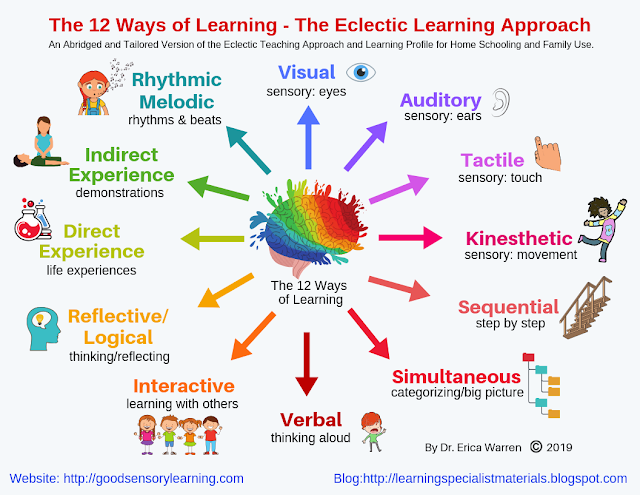
So instead of thinking about fixed or limited ways of learning, think about teaching students in ways that honor all 12 ways of processing information. This approach looks at:
- Visual Learning: incorporates pictures, drawings, and even personal visualizations. This helps students learn through imagery.
- Auditory Learning: involves learning through listening. This helps students to learn how to focus on and determine the salient information from what they are hearing.
- Tactile Learning: consists of touching or feeling objects or artifacts. It also involves the encoding of information when taking notes or drawing things out.
- Kinesthetic Learning: encompasses learning while moving one’s body. For many students, movement can help enhance engagement in learning and memory of information.
- Sequential Learning: entails teaching students in a step-by-step manner that sequences instruction by time, alphabetical order, or a numerical series. This prepares students for outlines, timelines, completing long-term assignments, and keeping materials organized.
- Simultaneous Learning: involves teaching children how to categorize materials. This prepares students for webbing information, conceptualizing main ideas, understanding flow charts and diagrams, as well as keeping materials organized.
- Verbal Learning: incorporates teaching children how to process ideas aloud. This helps students participate in class discussions and feel comfortable expressing ideas.
- Interactive: consists of teaching children how to work with others. This trains learners to collaborate and work in groups.
- Logical/Reflective Learning: encompasses teaching children how to reflect upon or think about what they are learning. This prepares students to work independently and process ideas internally.
- Indirect Experience Learning: entails teaching children how to watch and learn from a demonstration. This helps students attend to and glean information from vicarious learning experiences.
- Direct Experience Learning: involves teaching children how to use their own environment to learn. This informs students that continuing education is ever-present in our everyday surroundings and that there are fabulous learning experiences available through museums, aquariums, historic sites, and other locales.
- Rhythmic Melodic Learning: consists of teaching children how to use melodies and rhythm to learn. This provides students with the tools to utilize beats, songs, or melodies when trying to memorize novel information.

Are Some Unable to Learn all 12 Ways?
As long as our senses or brains are not damaged, we can process in all ways. But remarkably, even those with "broken" sensory inputs or head injuries can learn to compensate. Other senses and parts of the brain become more acute, and we are now learning, for example, that even a blind person can utilize their visual cortex and sound to create mental imagery or a "map" of their surroundings.
Should Students Learn to Step Out of Their Comfortable Ways of Learning?
Many learners like to follow the same, familiar learning path, but we, as teachers and parents, can help forge new trails and perspectives by introducing and demonstrating novel approaches. Although learning a new way can be time-consuming and lengthen the "hike," it ultimately teaches our students that they have options, they can grow, and we can help them to explore portions of the brain that are underutilized.
What Can Parents and Teachers Do?
To help each child attain his or her learning potential, let me suggest using the Student Processing Profile. This digital assessment offers reports, learning strategies, organizational strategies, materials/technology recommendations, and more. By utilizing the assessment, parents can uncover the unique learning profile of each family member. Then, printable handouts can suggest the needed strategies for success.
Cheers, Erica
Dr. Erica Warren is the author, illustrator, and publisher of multisensory educational materials at Good Sensory Learning. She is also the director of Learning to Learn and Learning Specialist Courses.
- Blog: https://goodsensorylearning.com/blogs/news
- YouTube Channel: https://www.youtube.com/user/warrenerica1
- Executive Function Podcast: https://goodsensorylearning.com/pages/the-personal-brain-trainer-podcast-with-dr-erica-warren
- Store: http://www.Goodsensorylearning.com/
- Courses: http://www.learningspecialistcourses.com/
- Newsletter Sign-up: https://good-sensory-learning.kit.com/drericawarren

Leave a comment
This site is protected by hCaptcha and the hCaptcha Privacy Policy and Terms of Service apply.