
Mindfulness Training Improves Weak Emotional Intelligence - Symptoms and Strategies Defined
I find that more and more parents and teachers are complaining that our youth have underdeveloped social skills. Instead of face-to-face encounters, many youngsters have their attention buried in their electronic devices, and they are not learning to read important social cues. As a result, many children are not developing their emotional intelligence.

We are now learning that mindfulness-based approaches can be very beneficial to the learning process and the development of emotional intelligence (inhibitory control). This is a form of metacognition (executive function) that can help youngsters gain a sense of control over both their thoughts and emotions. In addition, these practices can improve self-esteem and resilience.
What Does Mindfulness Have to Do with Emotional Intelligence?
Psychology Today defines emotional intelligence as "the ability to identify and manage your own emotions and those of other people." It involves the following three skills: emotional awareness, emotional application, and emotional management. Some believe that mindfulness is the foundation of emotional intelligence. By exercising our attention through mindfulness, we can actually teach the brain to become more emotionally astute, and this can improve executive functions at large. As an added benefit, people with a well-developed emotional intelligence usually display high levels of resilience, experience more trusting relationships, and are better able to manage their social interactions, attitude, and temperament.

What are Some Key Symptoms of a Weak Emotional Intelligence?
- Individuals often feel like others don’t “get it,” and it makes them feel impatient and frustrated.
- Individuals often criticize others.
- Individuals are easily annoyed or angered when someone disagrees with them or has a different opinion.
- Individuals are unaware or surprised that others are sensitive to their comments or jokes.
- Individuals believe that their ideas and assertions are right and rigorously defend them.
- Individuals find that others are to blame for their own mistakes.
- Individuals have trouble managing negative emotions.
- Individuals lack compassion or empathy for the feelings of others.
- Individuals resist learning anything new.
- Individuals have trouble reading facial expressions and nonverbal communication.
- Individuals easily give up when learning new content or when they reach a difficult problem.

What are Some Activities that Can be Done to Develop Emotional Intelligence?
- Read articles such as Victims of Bullying Live with the Consequences for Decades, Study Says, and lead a discussion about what your student or students learned from the article.
- Brainstorm mindful ways that students can manage stressful situations in school.
- Talk about the definition of resilience and grit. Ask students what they can do to develop these traits.
- Have your students take an online emotional intelligence test. Here are a couple of options:
Ready-Made Activity Cards for Developing Emotional Intelligence:
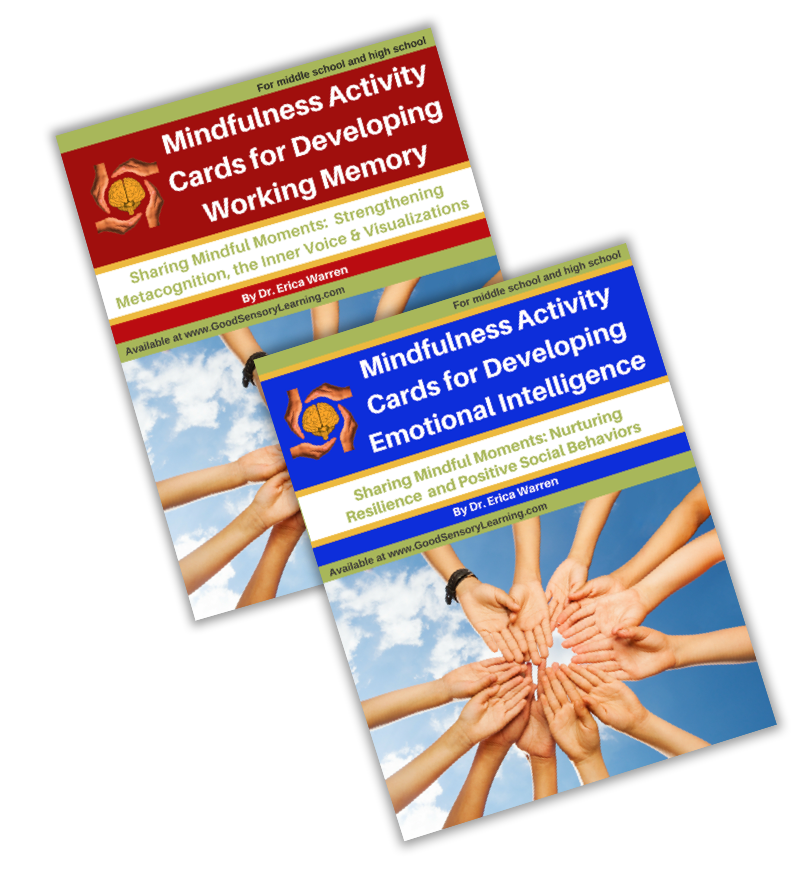
I created a set of Mindfulness Activity Cards for Developing Emotional Intelligence based on the current research on emotional intelligence and social-emotional learning. There are 50 cards in the set, and they can be used in therapeutic sessions or classrooms to help develop mindfulness, emotional regulation, emotional intelligence, resilience, and community. Additionally, they can be used to teach authentic dialogue and develop self-esteem. These task cards are ideal for individual sessions, round table discussions, and circle groups. I also have a series of Mindfulness Activity Cards for Developing Working Memory.
Would You Like to Watch a Video Blog on This Content?
Clearly, mindfulness is a valuable tool that can help students as well as their teachers. I hope you found this helpful!
Cheers, Erica
Dr. Erica Warren is the author, illustrator, and publisher of multisensory educational materials at Good Sensory Learning. She is also the director of Learning to Learn and Learning Specialist Courses.
- Blog: https://goodsensorylearning.com/blogs/news
- YouTube Channel: https://www.youtube.com/user/warrenerica1
- Executive Function Podcast: https://goodsensorylearning.com/pages/the-personal-brain-trainer-podcast-with-dr-erica-warren
- Store: http://www.Goodsensorylearning.com/
- Courses: http://www.learningspecialistcourses.com/
- Newsletter Sign-up: https://good-sensory-learning.kit.com/drericawarren


Leave a comment
This site is protected by hCaptcha and the hCaptcha Privacy Policy and Terms of Service apply.