
How to Improve Working Memory in Struggling Students
Did you know that a strong working memory is one of the best indicators of academic success? In contrast, those who struggle with a weak working memory often find learning, accessing prior knowledge, and solving problems in their mind challenging. So what is working memory all about?
What is Working Memory?
Working memory is like a mental sketchpad and guiding voice that allows us to solve problems in our heads. It's a complex cognitive process that involves a number of skills that need to work in concert.
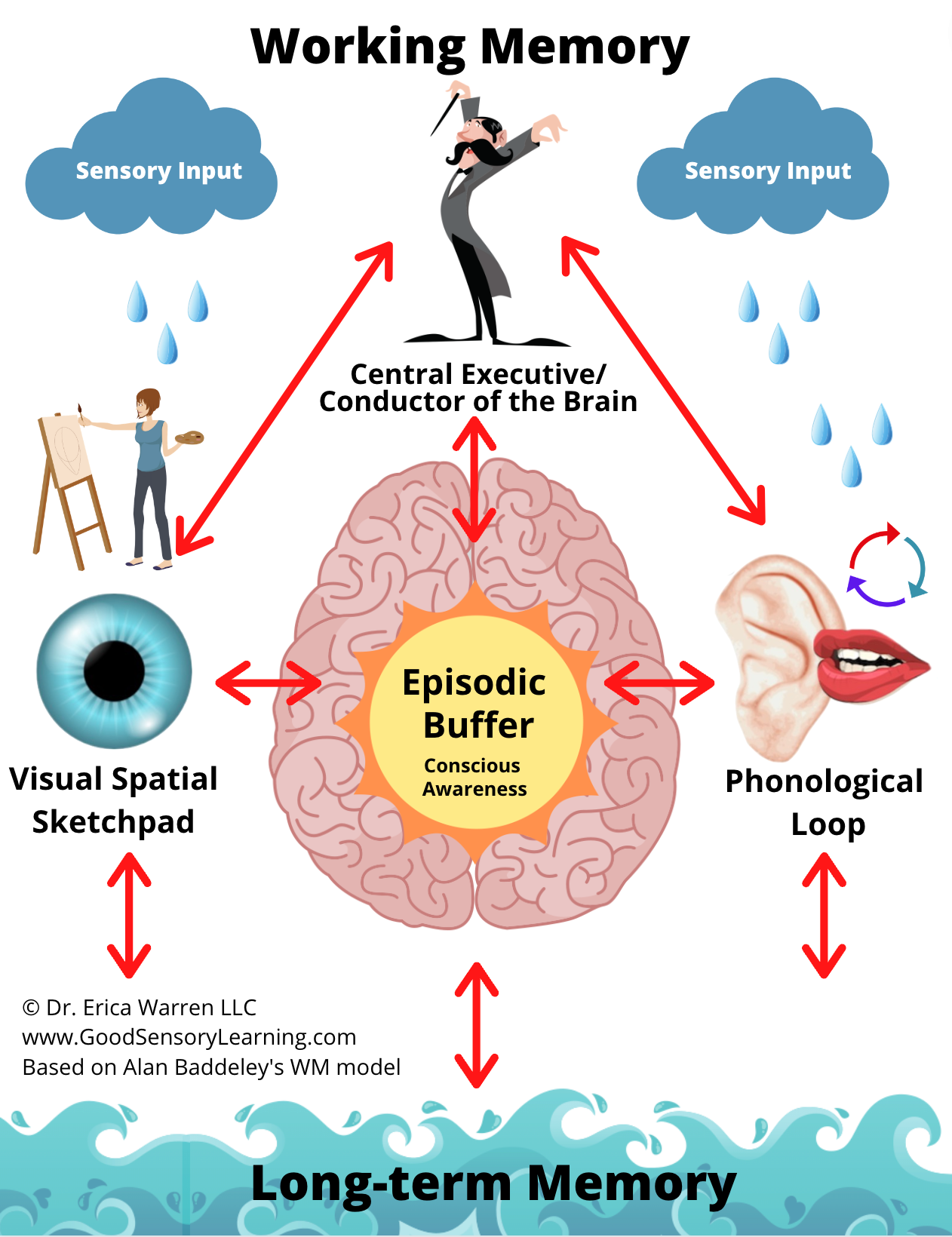
As illustrated in the image below, sensory inputs (represented by raindrops) flow into our perception. Then, our central executive (illustrated as a conductor of cognitive skills) manages four aspects of cognition:
- Attention (presented as the sun),
- Inner voice or inner dialogue (seen as the ear)
- Inner eye or mental visualizations (depicted as an eye)
- Long-term memory or prior knowledge (presented as the ocean)

There are several ways to strengthen working memory skills:
Take my comprehensive course on executive functions and study strategies.
- Teachers and parents can think aloud (metacognition). By sharing how one uses the inner voice and visualization skills, students can learn how to use their internal dialogue and mental imagery to solve problems.
- Consider online activities that strengthen working memory and executive functioning at large: CLICK HERE.
- Talk about visualization/imagination as well as the inner voice, and explain what it is to students and how they can use it to learn. If you would like to learn about my activity cards that offer discussion topics, CLICK HERE.
- Help to strengthen students' visualization skills with assessments, games, and activities. If you would like to learn more about this, check out my digital download: Teaching Visualization for Learning Bundle.
- Do fun activities and games that strengthen working memory. CLICK HERE to view some options.
COME LEARN ABOUT ALL MY WORKING MEMORY RESOURCES
Clearly, working memory is a vital cognitive processing skill that should be exercised and developed for students of all ages.
Come view my 3-minute video on working memory!
How Can I Learn More About Helping Students with Working Memory Weaknesses?
For a 50-minute workshop: CLICK HERE
For a comprehensive course: CLICK HERE

Cheers, Erica
Dr. Erica Warren is the author, illustrator, and publisher of multisensory educational materials at Good Sensory Learning. She is also the director of Learning to Learn and Learning Specialist Courses.
- Blog: https://goodsensorylearning.com/blogs/news
- YouTube Channel: https://www.youtube.com/user/warrenerica1
- Executive Function Podcast: https://goodsensorylearning.com/pages/the-personal-brain-trainer-podcast-with-dr-erica-warren
- Store: http://www.Goodsensorylearning.com/
- Courses: http://www.learningspecialistcourses.com/
- Newsletter Sign-up: https://good-sensory-learning.kit.com/drericawarren


Leave a comment
This site is protected by hCaptcha and the hCaptcha Privacy Policy and Terms of Service apply.