
Listening Skill Activities and Discovering the Causes
It is easy for parents and even teachers to lose their cool when children do not listen to repeated directions. So, if kids aren’t making sense of what they hear, how can the learning process even take place? To solve this problem, it is necessary to uncover the root causes of poor listening skills. Then, one must find the individualized, cognitive-based culprits for each student and remediate them.

What are the Cognitive Skills Behind Listening?
Several core cognitive skills support one's capacity to listen:
- Attention - Attention is the ability to tune into information, sensations, and perceptions that are relevant in the moment.
- Working memory - Working memory is a cognitive function that enables students to recall and use relevant information to complete an activity. It also enables learners to hold multiple pieces of information in the mind and manipulate them. Often described as a mental workspace, working memory helps students stay focused, block distractions, and stay abreast of their surroundings. If you are looking for ways to improve working memory, CLICK HERE
- Receptive language - Receptive language is your brain’s ability to receive verbal and nonverbal information presented in the environment. It can involve organizing thoughts, following a sequence of directives, or even maintaining attention. To learn more about solutions to both receptive and expressive language problems, CLICK HERE
- Auditory processing - Auditory processing is the brain's interpretation of the sounds we hear. A weakness in auditory processing is not a hearing issue, but with the understanding of what is heard. It's a complex skill that involves auditory synthesis, auditory closure, auditory sequencing, auditory discrimination, segmenting, and auditory memory. To learn more about understanding and remediating auditory processing, CLICK HERE.
- Nonverbal listening skills - Nonverbal listening skills are the visual cues or behaviors that one exhibits when paying attention. It is these cues or behaviors that communicate to the surrounding people that one is engaged and present. This includes eye contact as well as body language. For example, a disengaged child may slump in his chair and look out the window, while an engaged child gives direct eye contact, nods their head, and leans forward over the desk.
- Visualization - Visualization is an internal process, and developing children's ability to visualize can provide them with a secret weapon that can enhance learning capacity, improve memory, and spark creativity. In fact, the research shows that visualization improves reading comprehension, creative writing abilities, and the encoding and retrieval of math, history, and science concepts. To learn more about how visualization can improve attention and memory, CLICK HERE
- Metacognition - Metacognition is the self-regulation of one's own thinking, and it is often described as "thinking about thinking.” One uses higher-order reasoning, visualization, and one's inner voice to actively control the thought processes and maintain engagement in learning. If you want to learn more about metacognition and mindful strategies for students, CLICK HERE
Materials That Target Teaching and Strengthening Listening Skills:
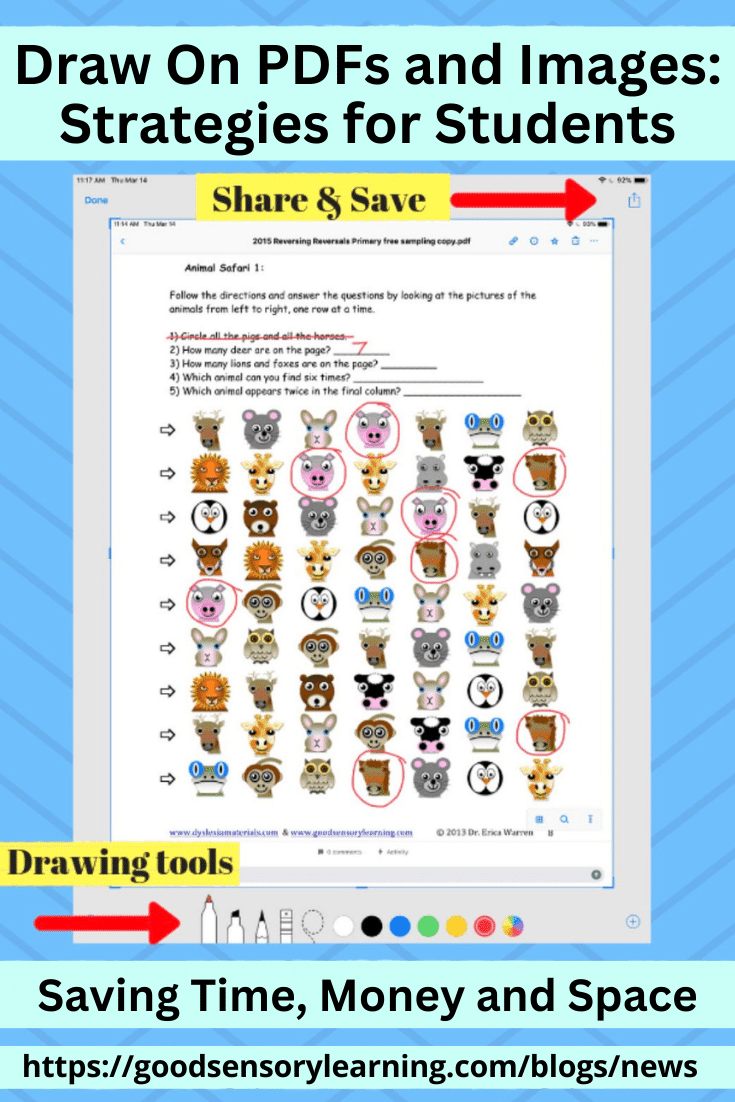
The Following Directions series, at Good Sensory Learning, was created to help students develop listening skills, follow written directives, comprehend test questions, and solve tricky multiple-choice problems. In addition, the activities improve attention skills, vocabulary, mental flexibility, spatial and sequential memory, as well as executive functioning abilities. To learn more about these fun publications, CLICK HERE or on the image below. Download some FREE Sample Activities today.

Individualizing the Remedial Approach
Cheers, Erica
Dr. Erica Warren is the author, illustrator, and publisher of multisensory educational materials at Good Sensory Learning. She is also the director of Learning to Learn and Learning Specialist Courses.
- Blog: https://goodsensorylearning.com/blogs/news
- YouTube Channel: https://www.youtube.com/user/warrenerica1
- Executive Function Podcast: https://goodsensorylearning.com/pages/the-personal-brain-trainer-podcast-with-dr-erica-warren
- Store: http://www.Goodsensorylearning.com/
- Courses: http://www.learningspecialistcourses.com/
- Newsletter Sign-up: https://good-sensory-learning.kit.com/drericawarren


Leave a comment
This site is protected by hCaptcha and the hCaptcha Privacy Policy and Terms of Service apply.